
Anthropic CEO Dario Amodei emphasized India's crucial role in addressing the challenges posed by AI, including autonomous behavior, misuse potential, and economic displacement, during his address at the India AI Impact Summit 2026.

Russian President Vladimir Putin and Chinese President Xi Jinping have reaffirmed their commitment to dismantling global hegemonism and building a 'multipolar world' during high-level talks in Beijing.

India has joined the US-led 'Pax Silica' alliance, aimed at building a resilient supply chain for critical minerals and artificial intelligence, marking a significant step in strengthening bilateral ties and fostering economic security.

Chinese leaders, including its generals, will have to weigh whether they can win a war if they ever attack Taiwan and if at all, can they sustain the subsequent devastation, notes Rup Narayan Das.

'OMCs are incurring losses of Rs 1,000 crore per day due to the West Asia crisis.'

India and Canada solidify their partnership with a landmark uranium supply agreement and discussions to finalise a comprehensive economic partnership, signaling stronger ties and cooperation on key global issues.

Vietnam is an emerging regional power and a closer relationship with Hanoi is closely aligned with Prime Minister Narendra Modi's Act East Policy, points out Dr Rajaram Panda.

US Treasury Secretary Scott Bessent's remarks come ahead of a high-level summit where India and the European Union are expected to formally announce the conclusion of negotiations on a comprehensive free trade agreement.

India should not stay on the margins of this initiative. There should be a serious debate about what would be in India's best interests asserts former foreign secretary Shyam Saran.
The US President had hosted Modi for an official working visit in Washington, DC, on February 13 last year.

'The focus will be on showing the real-world impact of AI in improving the lives of citizens and how it has helped in ensuring democratic access to technology for everyone.'

'Not the back office for the world's content. The leader. The standard-setter.'

European Commission President Ursula von der Leyen says India and the EU are close to a 'historic trade agreement' that could create a market of two billion people and account for almost a quarter of the global GDP.

Government schemes such as the PM E-Drive initiative, with allocations of around Rs 2,000 crore for charging points deployment, are helping accelerate rollout
If the US' renewed closeness with Pakistan ends up strengthening Pakistan's military, it will clearly show that Washington no longer wants a strong India and could be ready to let China dominate Asia, notes Colonel Anil A Athale (retd).

Describing the visit as "productive" in a post on X, the PM said he emphasised India's position on key global issues during his engagements.

India and Canada are negotiating a long-term uranium supply agreement worth $2.8 billion. They are also exploring expanded civil nuclear cooperation after the passage of the SHANTI Bill.
The statement suggests that Canadian authorities do not see ongoing foreign interference or violent activity tied to India at present.

China on Friday said the Shanghai Cooperation Organisation (SCO) summit to be held in Tianjin later this month will be the largest in the bloc's history, with 20 world leaders, including Prime Minister Narendra Modi, attending it.

'To suddenly give the impression of taking a position that is hostile to Iran, or, at least, not friendly to Iran, is not a good thing.'

Union Minister Kiren Rijiju criticises Congress leader Rahul Gandhi's parliamentary conduct, accusing him of being unduly influenced by advisors and questioning his casual attire in the House.

Both India and the EU are likely to announce a conclusion of trade talks on January 27.

India and the European Union are set to announce on January 27 the conclusion of negotiations and finalisation of a free trade agreement, which is aimed at boosting economic ties between the two regions amid disruptions in global trade due to US tariffs, an official said.

Commerce and Industry Minister Piyush Goyal announced that an interim trade agreement between India and the US is likely to be signed in March and operationalised in April, with chief negotiators meeting in Washington to finalize the details.

Trump stated that Russia will face "severe economic consequences" if Putin doesn't show interest in de-escalating the Ukraine conflict.

'Within six months I expect petrol, diesel, and electric vehicles (EVs) to reach cost parity,' says Union Minister for Road Transport and Highways Nitin Gadkari.
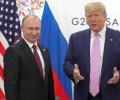
Taking to social media platform X, Dmitriev said, "Russia confirms Putin-Trump summit may happen next week and summit preparations are ongoing. This can be a historic meeting. Dialogue will prevail."
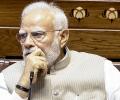
China welcomes Prime Minister Narendra Modi's planned visit to the Tianjin Summit of the Shanghai Cooperation Organisation (SCO), expressing hope that the event will be a 'gathering of solidarity, friendship and fruitful results'.

The 20th India Economic Summit to be held in New Delhi later this year will showcase India's advances and accomplishments in integrating with the global economy

Two days after Russian President Vladimir Putin concluded his visit to India, during which he assured that Moscow would remain a reliable energy supplier, the Kremlin on Monday said that India, as a sovereign nation, is free to buy oil from sources it deems beneficial. It expressed confidence that New Delhi will continue to prioritise its economic interests.
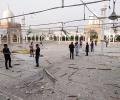
Chinese Foreign Minister Wang Yi stated that China mediated tensions between India and Pakistan, a claim disputed by India which maintains that the matter was resolved bilaterally.

IMF Managing Director Kristalina Georgieva discusses the potential of artificial intelligence to boost global growth, particularly in India, while also addressing the significant risks of job displacement and financial instability.

'At COP30, the emphasis will be on unlocking climate finance, reinforcing the principle of common but differentiated responsibilities, and building resilience through inclusive transitions and the mainstreaming of adaptation.'
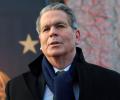
In the wake of the FTA between India and the European Union, the United States has described the Europeans as 'very disappointing', saying they were unwilling to join Washington, DC in putting tariffs on New Delhi for its purchases of Russian oil because of this trade deal.
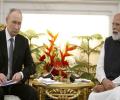
Prime Minister Narendra Modi strongly supported efforts to end the war in Ukraine and conveyed to Russian President Vladimir Putin that India will stand shoulder-to-shoulder in all peace efforts to find an amicable solution to the conflict.

Putin's State visit will centre on fixing the huge India-Russia trade imbalance, with both sides pushing to lower duties, ease non-tariff barriers, and seal a landmark mobility pact to send more Indian workers to Russia.

A top Swiss official has emphasised the growing importance of science and technology in international affairs, leading Switzerland to prioritise anticipatory science diplomacy in its foreign policy. Collaboration with India reflects a shared vision between two global innovation leaders.

By all available indications, the White House drafted a face-saving note and handed it, ready-made, to Islamabad. Pakistani Prime Minister Shehbaz Sharif was supposed to then post it in the guise of a plea urging Trump to extend the deadline by two weeks 'to allow diplomacy to run its course'. Trump would then graciously accept Pakistan's 'request' and declare a ceasefire. Sharif dutifully posted the message on X. Except that he, or whoever was handling the account, forgot to delete the tell-tale first line visible in the edit history: 'Draft - Pakistan's PM Message on X'. Prem Panicker's must read blog on the Iran War.

India and Russia are poised to sign multiple agreements to bolster cooperation in various sectors, including trade and healthcare, during Russian President Vladimir Putin's visit to New Delhi. Discussions will also address the Ukraine conflict and efforts to increase Indian exports to Russia.
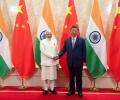
Prime Minister Narendra Modi and Chinese President Xi Jinping held bilateral talks focusing on economic ties and global stability amid trade tensions and the aftermath of the Ladakh border row.
